Studying How Autonomy, Flow, and Environmental Pressure Shape Human Expression
The Expressive Space Lab is an independent academic research initiative examining how social, digital, and institutional environments support or disrupt psychological engagement, identity, well-being, and sustained creative activity.
What We Study
The Expressive Space Lab is an independent undergraduate research initiative examining how autonomy, Flow, identity, and environmental pressure shape human expression and psychological engagement.
The current research agenda focuses on the conditions that support or disrupt meaningful creative activity. Particular attention is given to perceived control, self-monitoring, institutional constraint, social support, and the psychological consequences of unstable or opaque systems.
This work is presently in the conceptual development, literature review, and methodological training stage. Its purpose is to build testable questions that can later be examined through faculty-supervised psychological research.
How perceived choice, control, and intrinsic motivation influence deep creative engagement.
Autonomy and Flow
Environmental Pressure
How unstable rules, external evaluation, surveillance, and institutional constraints shape behavior and identity.
Sustainable Engagement
How psychological safety, social support, transparency, and Flow contribute to well-being, persistence, and reduced burnout.
The Expressive Space Framework
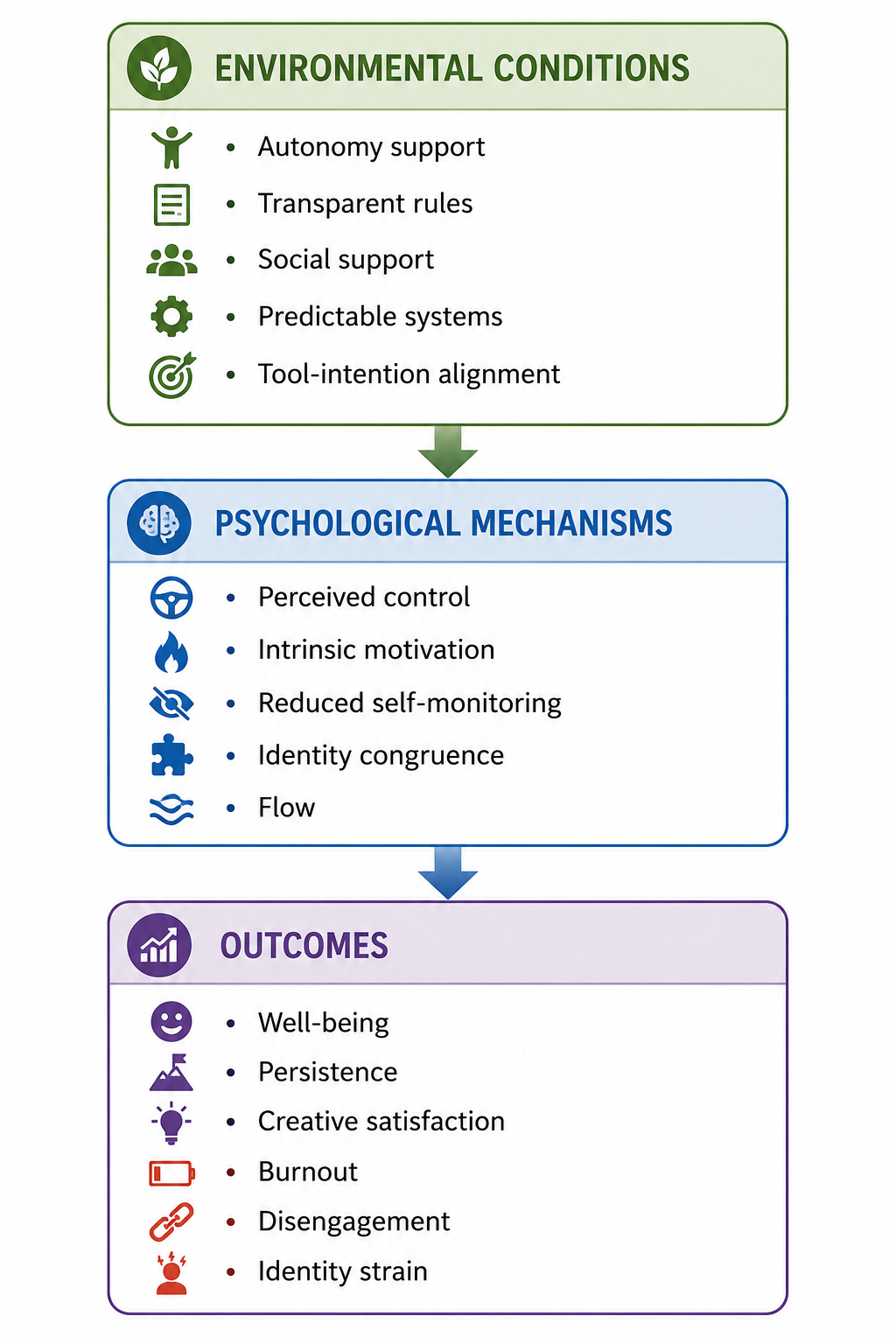
The Expressive Space Framework proposes that human expression is shaped by the relationship between environmental conditions, psychological mechanisms, and longer-term outcomes.
Supportive environments may strengthen autonomy, perceived control, identity congruence, and Flow. Unstable or coercive environments may increase self-monitoring, psychological strain, burnout, withdrawal, and disengagement.
The framework is currently conceptual. Its next stage is to refine the variables, compare them with established psychological theory, and develop faculty-supervised studies capable of testing its claims.
Current Research Questions
These questions are not presented as settled conclusions. They represent the current empirical direction of the framework and will require careful measurement, comparison with established theory, and ethical research design.
-
How does perceived autonomy influence the likelihood and quality of Flow during creative work?
-
Does performance-based self-monitoring interfere with concentration, intrinsic motivation, and sustained creative engagement?
-
How do unstable rules, opaque evaluation systems, and unpredictable feedback affect psychological well-being and persistence?
-
Can social support, transparency, and identity congruence protect individuals from burnout, disengagement, and expressive strain?
Featured Working Paper
The Expressive Space Framework: Supporting Creator Well-Being and Sustainable Engagement in Digital Ecosystems
This conceptual paper introduces the framework’s central concern: how autonomy, Flow, transparency, and social support may shape sustainable psychological engagement in digital environments.
The Expressive Space Framework:Supporting Creator Well-Being and Sustainable Engagement in Digital Ecosystems

About the Researcher
J. Matthew Pierce is a psychology student and emerging researcher focused on autonomy, Flow, identity, and human adaptation within social, digital, and institutional environments. His early conceptual work was developed during his studies at Ottawa University and continues through independent scholarship and academic methodological training.